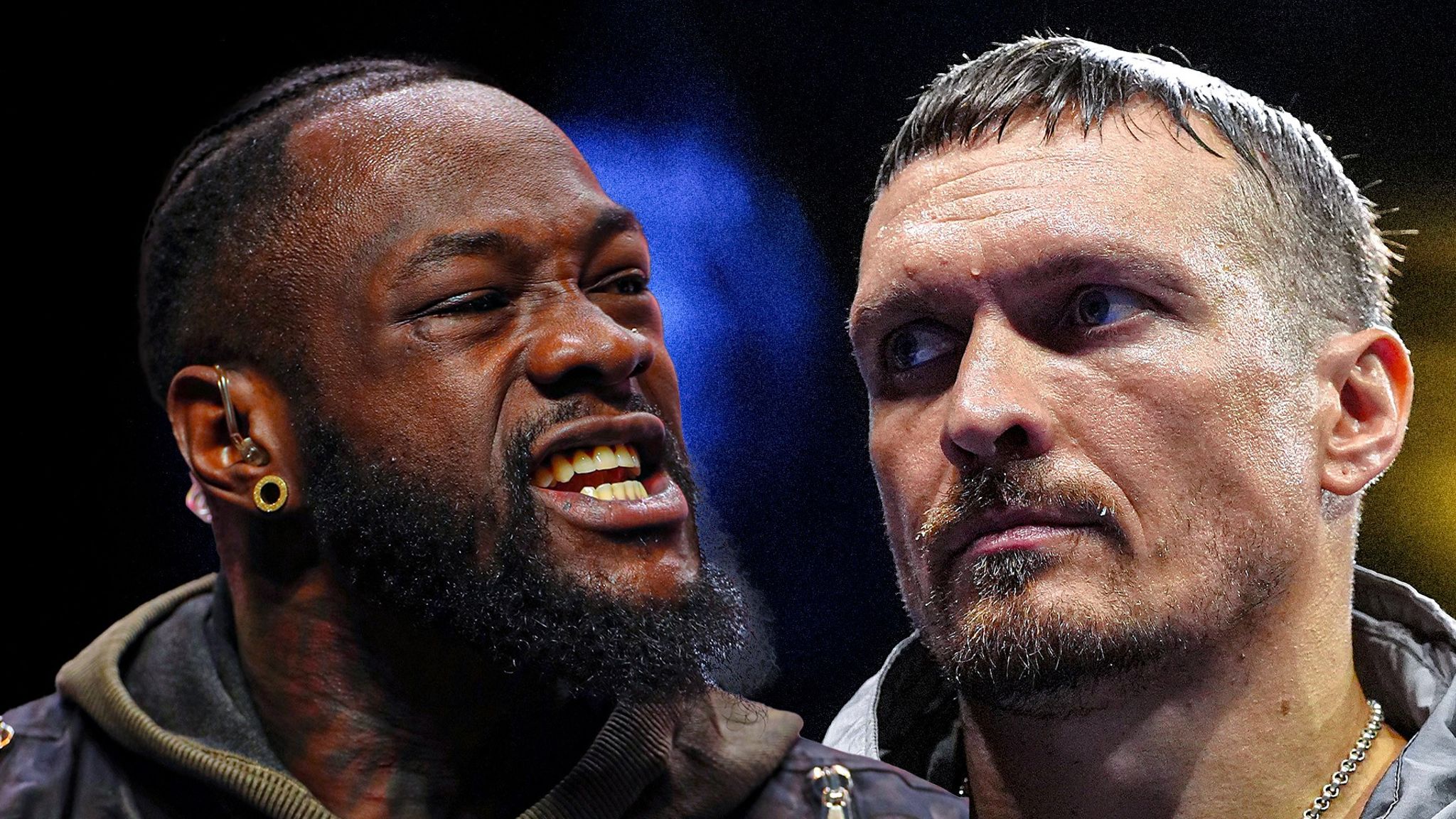
One Loss Could End It: Deontay Wilder Puts Usyk Title Shot on the Line
Deontay Wilder has the kind of late-career opportunity most heavyweights never get twice. A 2026 showdown with Oleksandr Usyk is agreed, approved by the World Boxing Council, and built around the one scenario that still makes Wilder dangerous against an elite technician: the single, division-shifting punch.
Now he is prepared to put that entire pathway at risk.
The former WBC champion is willing to take a grudge match with Derek Chisora first, and the logic behind it has become increasingly hard to defend when measured against Wilder’s recent form, activity, and margin for error.

JUST IN: Why Canelo Alvarez Is Being Told To Steer Clear Of This Dangerou
The Usyk sell was simple: one punch, one night
The Usyk angle worked because it was clean and contained. Wilder’s power has always allowed him to exist outside conventional momentum provided by technically gifted boxers, and his most recent win gave fans a reason to buy into that one last time.
But the moment you turn that into a two-step plan—win one fight, then land the same kind of fight-changing shot again—the story stops being intriguing and starts becoming implausible.
Wilder has lost four of his last six fights, been knocked out in three of them, and all of it has unfolded inside a five-year window. That isn’t a brief stumble. It is a sustained slide that shrinks the likelihood of back-to-back chaos moments.
He hasn’t delivered consecutive decisive knockout performances in seven years, since 2019 against Dominic Breazeale and Luis Ortiz—arguably his most destructive year to date.
Expecting him to produce that kind of outcome in two straight fights at 40 is not a leap of faith. It is a triple-jump away from what his recent career has actually shown.
Why Chisora is the wrong kind of risk
Against Usyk, Wilder’s job description was obvious: survive, wait, and swing once. The entire build can be framed around that single chance.
Against Chisora, the same premise doesn’t hold. Chisora is not a stylistic chess match. He is a pressure heavyweight who makes fights physical, uncomfortable, and messy—exactly the kind of environment where a fading margin for error matters.
On form alone, Chisora can reasonably be viewed as the favorite. Wilder’s reduced output, fading explosiveness, and shorter late-fight window mean he is no longer operating with the same inevitability when rounds pile up.
Asking him to land two separate miracle shots in consecutive outings is a different proposition than asking him to score with one.
Location only sharpens the danger. If Wilder goes to London for what is expected to be Chisora’s 50th and final fight, he is stepping into a setting built to lift the home fighter.
If Wilder loses there, and that’s a real possibility here, the Usyk fight doesn’t merely get delayed—it disappears.
Boxing has already seen this movie
This is not uncharted territory. Heavyweight boxing just watched a massive event vanish when long-term plans were put ahead of immediate reality.
In 2023, the decision to pit Wilder and Anthony Joshua in separate fights ended in disaster. Wilder lost to Joseph Parker, wiping out the long-awaited rivalry bout in a single night.
The warning was clear: if the “big one” is truly there, you don’t gamble it on an unnecessary hurdle.
The stakes here are even higher because the Usyk fight has a clear commercial target. Usyk is looking for a major United States headliner, with Las Vegas the natural stage, and Wilder remains the kind of name that can help sell it.
That narrative has timing and global relevance. Chisora risks tearing it up for a fight that offers limited upside and enormous downside.
Let’s be honest: if Chisora wins and extends his career to a 51st bout, the Usyk opportunity is gone for Wilder, replaced by a scenario that offers sentiment but little sporting upside.
The difference between bold and reckless
This is not about avoiding danger. It is about choosing the right danger for Wilder.
The Usyk fight made sense precisely because it acknowledged Wilder’s reality while still leaving a window for something extraordinary.
Choosing Chisora asks Wilder to repeat the extraordinary twice in a row, at 40, after years of decline, in a hostile setting where a loss is entirely plausible.
If Wilder wants the Usyk moment, this is the kind of detour that can end it before it begins.
