Tag

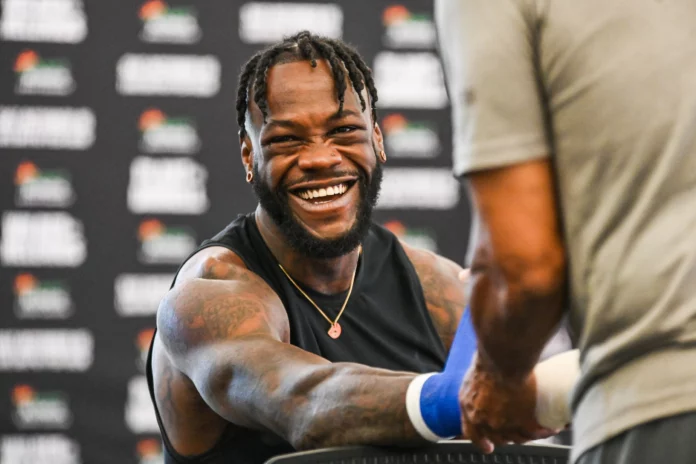
Deontay Wilder

Browsing

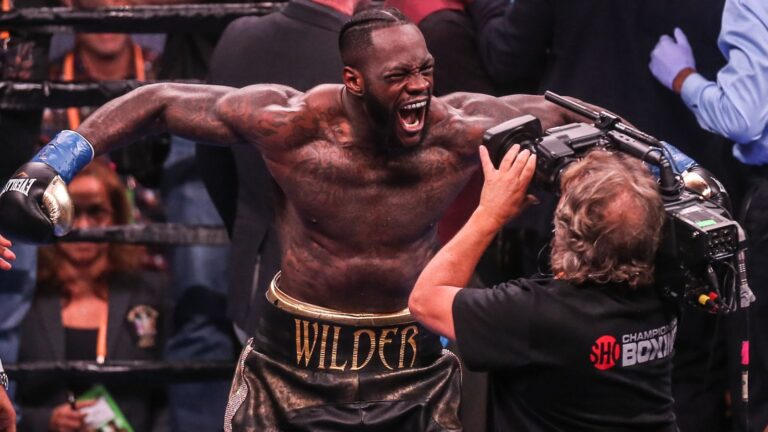
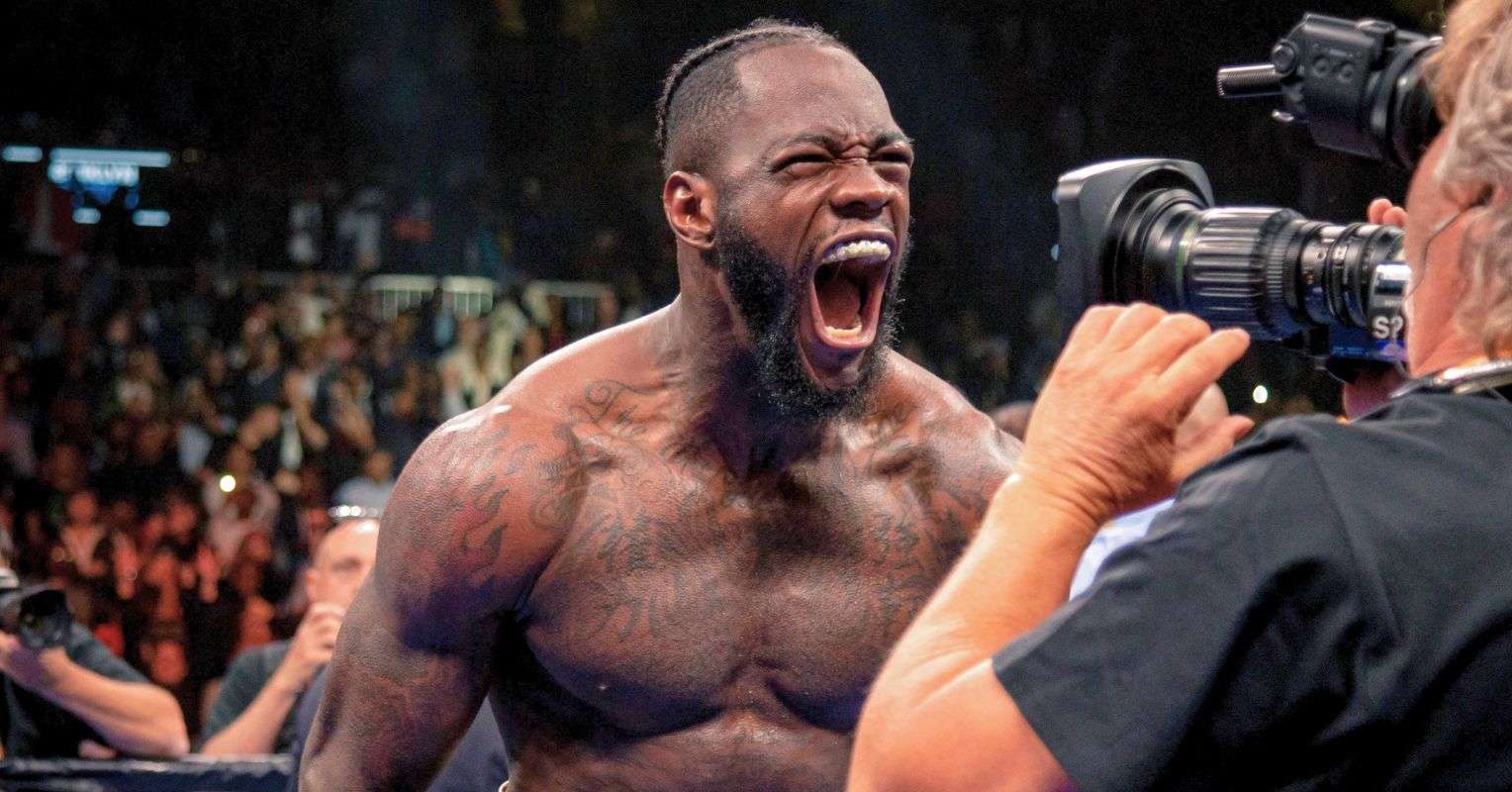
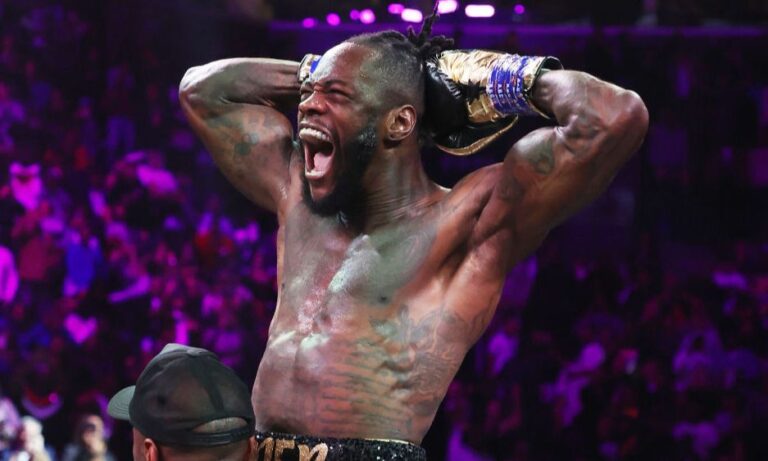
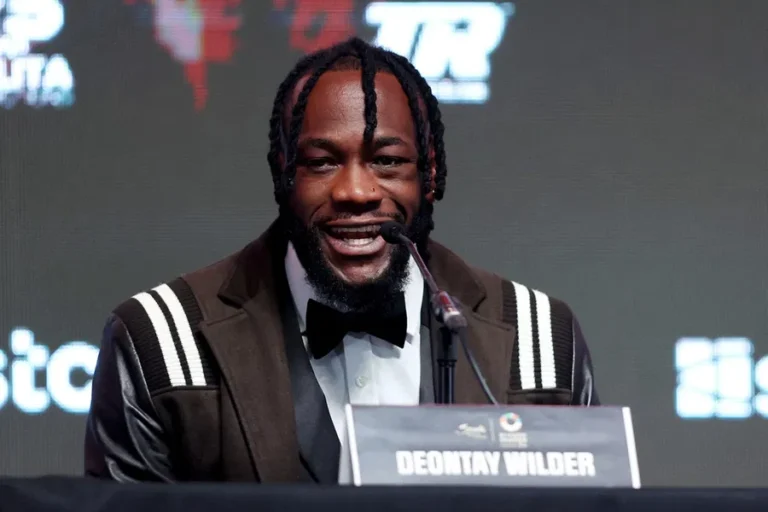
Deontay Wilder reveals why he chose Chisora over title fight with Usyk

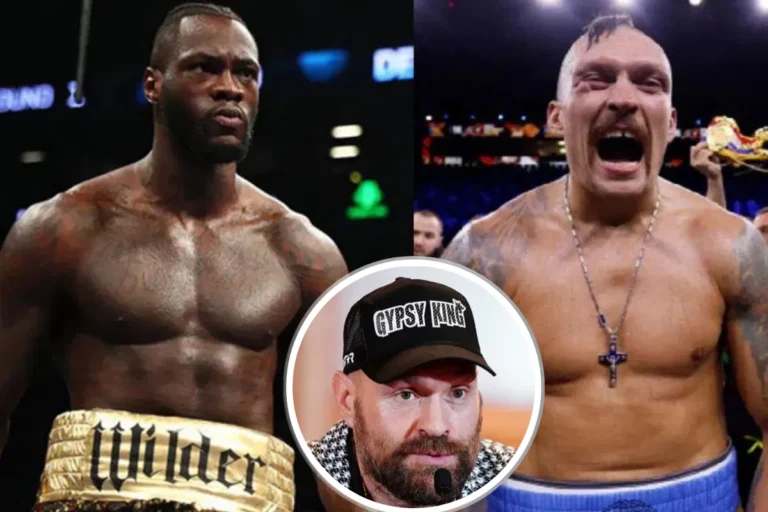
Deontay Wilder has revealed why his mooted matchup with Oleksandr Usyk, for the unified world heavyweight crown, has been replaced by a non-title fight against Derek Chisora.

The former WBC champion was called out by Usyk towards the end of last year, with both parties entering negotiations for their showdown to take place in America.

Earlier this month, though, heavyweight veteran Chisora emerged as a rumoured opponent for ‘The Bronze Bomber’, who also happens to be gearing up for his 50th professional outing.

Deontay Wilder reveals why he chose Chisora over title fight with Usyk

READ: Anthony Joshua: Concerning New Details Emerge About Driver In

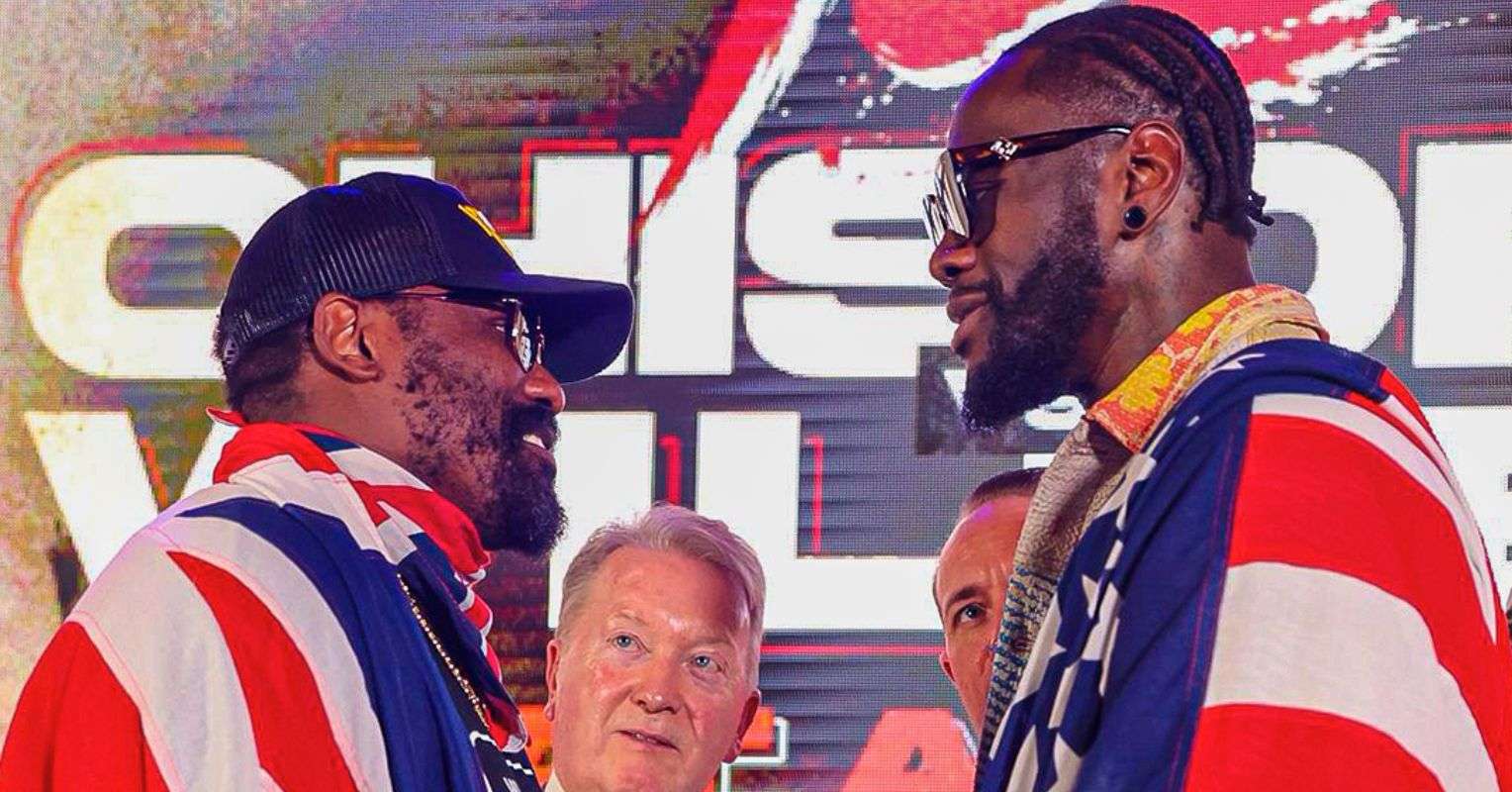
With 100 fights between them, it has now been confirmed that the pair will collide on April 4, headlining a Misfits Pro card in London.

Chisora comes off a string of points victories over Gerald Washington, Joe Joyce and Otto Wallin, which followed his punishing stoppage defeat to Tyson Fury in 2022.

At the age of 42, it is certainly fair to say that the Londoner has seen better days; but so too has Wilder, whose last contest saw him labour to a seventh-round finish over Tyrrell Herndon in June.

Prior to that, the 40-year-old had suffered back-to-back defeats to Joseph Parker and Zhilei Zhang, with the two fights ending via a wide unanimous decision and fifth-round stoppage, respectively.

But now, Wilder has secured himself a more winnable fight than his scuppered assignment against Usyk, which, speaking with Daily Mail Boxing, he claims talks with the Ukrainian were simpy dragging on too long.

“When you’re in negotiations, sometimes things just take longer than [you expect].

“There was a lot going on – I don’t want to put words in nobody’s mouth, but the process was taking too long. We needed to get out and get a fight.

“I wouldn’t want to call it a warm-up fight – Derek’s no pushover, he’s coming to fight. I’m mentally, physically and emotionally prepared for that.”

With Usyk coming off a fifth-round stoppage victory over Daniel Dubois, and having expressed his desire to enter at least two more fights, it remains to be seen who he will now defend his WBC, IBF and WBA titles against.

Deontay Wilder Vs. Derek Chisora Complications Why The Fight May Never Happen

Heavyweight veterans Deontay Wilder and Derek Chisora are reportedly finalizing a clash for April 4, but Frank Warren has something to say about that.

The news broke after Chisora posted a social media clip showing a video call with Wilder, during which “War” Chisora held up what appeared to be a signed bout agreement. Wilder is looking to reclaim his status as the division’s most feared puncher after a rocky stretch. Wilder returned to winning ways in June 2025 with a seventh-round TKO of Tyrrell Anthony Herndon, putting behind the losses he suffered to Joseph Parker and Zhilei Zhang.

JUST IN: How Terence Crawford’s Canelo Win Faces A Second Test

“Signed. I hope you’re ready. This is the last phone call from me too, bro. I’m just phoning to tell you, bro, good luck,” Chisora

“Let’s freaking go! If I’m not ready then I’m gonna get ready. I’m just going to let you know, I love you, bro, this is the last phone call. Next time I see you it will be at the press conference and then after that we’ll be in the ring, baby. I love you so much, brother. Let’s make it happen,” Wilder

Will It Happen?

Meanwhile, Chisora has defied age by winning three consecutive fights, as the 42-year-old most recently beat Otto Wallin in February 2025. Despite the excitement, the fight faces significant issues. Reports suggest the card is being organized by Kalle Sauerland and Wasserman Boxing under the Misfits Pro banner. Frank Warren issued a firm rebuttal, stating that Chisora remains under a binding contract with Queensberry Promotions.

“I’m not [with Queensberry] anymore. The contract I had with Queensberry expired two months after my fight with Otto Wallin. The reason why we didn’t fight in December is I didn’t get a good contract, so I didn’t fight in December. So right now I’m just waiting on getting a good contract, a good number, and I’ll fight,” Chisora stated

“[Chisora] has a contract with us. What we deal with is facts, and the fact is that he has a contract with us,” Warren said

One Loss Could End It: Deontay Wilder Puts Usyk Title Shot on the Line 

Deontay Wilder has the kind of late-career opportunity most heavyweights never get twice. A 2026 showdown with Oleksandr Usyk is agreed, approved by the World Boxing Council, and built around the one scenario that still makes Wilder dangerous against an elite technician: the single, division-shifting punch.

Now he is prepared to put that entire pathway at risk.

The former WBC champion is willing to take a grudge match with Derek Chisora first, and the logic behind it has become increasingly hard to defend when measured against Wilder’s recent form, activity, and margin for error.

Derek Chisora V Deontay Wilder will allegedly be promoted by Wasserman  Boxing if made official, and will potentially take place on April 4th 2026  at The O2 Arena in London U.K :

JUST IN: Why Canelo Alvarez Is Being Told To Steer Clear Of This Dangerou

The Usyk sell was simple: one punch, one night
The Usyk angle worked because it was clean and contained. Wilder’s power has always allowed him to exist outside conventional momentum provided by technically gifted boxers, and his most recent win gave fans a reason to buy into that one last time.

But the moment you turn that into a two-step plan—win one fight, then land the same kind of fight-changing shot again—the story stops being intriguing and starts becoming implausible.

Wilder has lost four of his last six fights, been knocked out in three of them, and all of it has unfolded inside a five-year window. That isn’t a brief stumble. It is a sustained slide that shrinks the likelihood of back-to-back chaos moments.

He hasn’t delivered consecutive decisive knockout performances in seven years, since 2019 against Dominic Breazeale and Luis Ortiz—arguably his most destructive year to date.

Expecting him to produce that kind of outcome in two straight fights at 40 is not a leap of faith. It is a triple-jump away from what his recent career has actually shown.

Why Chisora is the wrong kind of risk
Against Usyk, Wilder’s job description was obvious: survive, wait, and swing once. The entire build can be framed around that single chance.

Against Chisora, the same premise doesn’t hold. Chisora is not a stylistic chess match. He is a pressure heavyweight who makes fights physical, uncomfortable, and messy—exactly the kind of environment where a fading margin for error matters.

On form alone, Chisora can reasonably be viewed as the favorite. Wilder’s reduced output, fading explosiveness, and shorter late-fight window mean he is no longer operating with the same inevitability when rounds pile up.

Asking him to land two separate miracle shots in consecutive outings is a different proposition than asking him to score with one.

Location only sharpens the danger. If Wilder goes to London for what is expected to be Chisora’s 50th and final fight, he is stepping into a setting built to lift the home fighter.

If Wilder loses there, and that’s a real possibility here, the Usyk fight doesn’t merely get delayed—it disappears.

Boxing has already seen this movie
This is not uncharted territory. Heavyweight boxing just watched a massive event vanish when long-term plans were put ahead of immediate reality.

In 2023, the decision to pit Wilder and Anthony Joshua in separate fights ended in disaster. Wilder lost to Joseph Parker, wiping out the long-awaited rivalry bout in a single night.

The warning was clear: if the “big one” is truly there, you don’t gamble it on an unnecessary hurdle.

The stakes here are even higher because the Usyk fight has a clear commercial target. Usyk is looking for a major United States headliner, with Las Vegas the natural stage, and Wilder remains the kind of name that can help sell it.

That narrative has timing and global relevance. Chisora risks tearing it up for a fight that offers limited upside and enormous downside.

Let’s be honest: if Chisora wins and extends his career to a 51st bout, the Usyk opportunity is gone for Wilder, replaced by a scenario that offers sentiment but little sporting upside.

The difference between bold and reckless
This is not about avoiding danger. It is about choosing the right danger for Wilder.

The Usyk fight made sense precisely because it acknowledged Wilder’s reality while still leaving a window for something extraordinary.

Choosing Chisora asks Wilder to repeat the extraordinary twice in a row, at 40, after years of decline, in a hostile setting where a loss is entirely plausible.

If Wilder wants the Usyk moment, this is the kind of detour that can end it before it begins.

Questions about Deontay Wilder’s future have resurfaced following comments from former world champion Carl Froch, who suggested the heavyweight’s career has entered a markedly different phase.

Once defined by knockout power and intimidation, Wilder is now at the center of a more reflective discussion about longevity, direction, and the realities that come with time at the elite level.

The discussion has shifted away from potential matchups and toward a broader reassessment of where Wilder now stands in his career.

Deontay Wilder down in Fury 3

JUST IN: Authorities Unable To Locate Gervonta Davis

Froch questions what comes next
Speaking about Wilder’s recent run, Froch raised doubts about whether the former WBC heavyweight champion still has a clear route back toward the top of the division.

“What’s next for him?” Froch asked. “Has he got a career left? I just think that he’s lost four of his last six fights.”

Rather than focusing on any single defeat, Froch framed his view around what he sees as a growing gap between Wilder’s reputation and his recent performances.

“It’s all smoke and mirrors now,” Froch continued. “Everyone thinks he’s back with that big punch, and they want to see him get in there.”

A career shaped by power and consequence
Wilder’s rise through the heavyweight ranks was built almost entirely on knockout ability, a trait that carried him to a world title and sustained his presence at the elite level for years. Froch suggested that the physical toll of repeated high-stakes fights has altered that balance.

“I know it’s sad to say that, but at forty years old, the three fights with Fury done him,” Froch said, referencing the cumulative impact of Wilder’s trilogy with Tyson Fury.

While such assessments remain a matter of opinion, they reflect a broader reality faced by fighters whose success was built on singular strengths over extended periods.

Reflection replacing anticipation
For much of his career, Wilder’s place in the heavyweight picture was fueled by anticipation — the belief that one punch could always reset the narrative. Froch’s comments, instead, point toward a stage in which past accomplishments are increasingly weighed against present limitations.

“I know everyone has their own reasons and everyone is entitled to do what they want,” Froch added. “But it’s sad to see, really.”

Whether Wilder chooses to continue or step away remains his decision alone. What has changed is the tone of the conversation surrounding him, which has shifted from expectation toward reflection as his career is increasingly viewed through a longer-term lens.

Oleksandr Usyk is remains set on a fight against former WBC heavyweight champion Deontay Wilder.

The Ukrainian superstar was last in action back in July when he stopped Daniel Dubois in the 5th round of their Wembley Stadium rematch, becoming the first fighter of the ‘four belt era’ to win the undisputed heavyweight championship twice.

Despite speculation that the 38-year-old could draw the curtain on his glittering professional career, but the man himself has said he will be fighting two or three times more and set his sights on Wilder.

Deontay Wilder’s team react to reports he’ll face Usyk in front of record crowd

JUST IN: ‘He is truly grateful’ – Eddie Hearn shares Anthony Joshua update a

‘The Bronze Bomber’ bounced back from consecutive defeats to Joseph Parker and Zhilei Zhang last June, stopping countryman Tyrrell Herndon in the 7th round of their non-title clash at the Charles Koch Arena in Wichita. Despite the win, it was an underwhelming showing, leading most to question why he deserves a shot against the unified champion.

In a recent interview with Ready To Fight, Usyk revealed exactly why he wants the fight next as he looks to extend his unbeaten record to 25-0.

“First of all, it’s the USA — I want to box in America. Secondly, Wilder has been at the top for the last 10 years. This is about sporting interest. In the “big three,” there were Joshua, Fury, and Wilder. I beat Joshua twice, I beat Fury twice, and one unbeaten one remains — Wilder.”

Since making the step up from cruiserweight back in 2019, Usyk has produced legacy-defining victories over the likes of Anthony Joshua, Daniel Dubois and Tyson Fury, establishing himself as arguably the greatest heavyweight of his generation. From that perspective, it makes sense that he would like to add Wilder to the list, as he is part of the ‘big three’ heavyweights of this generation alongside Fury and ‘AJ.’

The Puncher’s Chance Problem In A Wilder Vs Usyk Fight

Deontay Wilder is being given a puncher’s chance in a potential fight against Oleksandr Usyk, but little else.

Public reaction has been close to unanimous. Social media and much of the boxing press view the matchup as a mismatch. At 40, Deontay Wilder is widely seen as a faded force. His record since 2020 supports that view. He has won only two of his last six fights in that span, with the losses coming decisively.

Deontay Wilder responds to Oleksandr Usyk callout as former Tyson Fury  nemesis reveals plans for 2026

JUST IN: Anthony Joshua Retirement: Family Claims and Fake AI Video

There remains a small group of fans who believe Wilder can still change any fight with one clean right hand. That belief rests on what he was earlier in his career. The theory is simple. If Wilder is healthy and willing to take risks, one mistake could still be punished. It is a narrow argument, but it continues to follow him.

The stylistic problem is that Usyk is built to reduce exactly that threat. As a southpaw, he keeps his lead foot outside and shifts angle immediately after punching. He stays active with his lead hand, disrupting rhythm and forcing opponents to reset their feet before they can load up.

That reset places right handers in a dead zone where power cannot be delivered cleanly without time. Against a mover like Usyk, that time rarely exists. Wilder’s recent form has only added to the skepticism. In his last fight against Tyrrell Anthony Herndon, he relied heavily on his left hand and jab, scoring a seventh round knockout without sustained right hand attacks. After the fight, Wilder said long standing shoulder issues had required two surgeries and limited him for years.

That context reframes the puncher’s chance. Even if the shoulder problems are behind him, the version of Wilder seen recently has been more measured and selective. Against Usyk, that creates a difficult choice. Patience allows Usyk to control pace and space. Aggression forces repeated resets before the right hand can be thrown.

The fight remains in negotiations for April or May in Las Vegas. Fan preference has pointed elsewhere, toward names such as Moses Itauma, Fabio Wardley, Agit Kabayel, Joseph Parker, or Frank Sanchez.

The appeal here rests on one question only. Whether a weapon that once defined a career can still function against an opponent designed to take it away. The stylistic gap is not just technical. It is temporal.

‘He got grits in his gloves’: Deontay Wilder names the hardest puncher he faced (and it’s not Tyson Fury)

Deontay Wilder, despite four defeats in his last six fights, has been linked with a 2026 fight against Oleksandr Usyk. Wilder’s legacy will undoubtedly be his extraordinary punching power. He was behind in some fights, but found a way to win with that dynamite right hand. In a recent interview with Vegas Insider, The Bronze Bomber revealed the hardest puncher he’s ever faced.

Showtime Championship Boxing" Deontay Wilder vs. Tyson Fury (TV Episode  2018) - IMDb

JUST IN: Jake Paul Handed Career Blow Two Weeks After Anthony Joshua

Deontay Wilder recalls punching power of Johann Duhaupas

Wilder has stopped 43 fighters in his 44 wins. It’s an unbelievable record, but it hasn’t always been plain sailing for the Alabama native, who has been behind in fights and struggled against certain opponents. Looking back on the hardest puncher he’s ever faced, many would expect Wilder to name Fury, but The Bronze Bomber named a surprising opponent as the biggest puncher:

“Like I said, I’m an energy person now. It may change throughout the years, but right now, when I think about the hardest.

“I can remember that the feeling in the ring was Johann Duhaupas, the Frenchman.

“Like every time he hit me with his jab and shit, I kept in my head. I was like, God damn. He hit hard.

“Damn. He got grits in his gloves.

“I kept saying, I can’t keep taking these jabs, you know?

“He was the only fighter that made me just really just think like that.

“Like if I got hit, like, dang, that hurt.

“That’s only what I could remember. So I always give him that gratitude, you know, and that acknowledgement.

“So, salute. Salute, bro. I still think about you.

“He hit me so hard, I still think about him!”

Deontay Wilder in 2026 and beyond

What’s left for Deontay Wilder? His taxing trilogy against Tyson Fury appeared to take a lot out of both fighters. After more than 14 months out of the ring, Wilder returned to big-time boxing, losing to Joseph Parker, and then suffering a defeat against Zhilei Zhang. The Bronze Bomber returned this year, stopping Tyrrell Herndon.

In the win against Herndon, Wilder (44-4-1, 43 KOs) was relatively in control, using his jab effectively, with Herndon only having limited success. Wilder scored a knockdown in round two, despite Herndon protesting that it was a slip. As the rounds progressed, Herndon began to fatigue, with Wilder landing some big shots. This pressure from The Bronze Bomber led to a second knockdown.

In the seventh round, Wilder landed two right hands, which prompted the referee to jump in to wave the fight off. The use of the jab by Wilder was undoubtedly positive, but his timing was off. That is not unexpected given his inactivity in recent years. Is Wilder ready for a showdown with Usyk? Absolutely not! If Wilder is to make any further impact in the heavyweight division, we need to see him in a winnable fight against someone who will pose him questions. That’s when we will see if Deontay Wilder has the answers.

Speaking to WBN, Sergey Lapin, Usyk’s Team Director, confirmed the long-term strategy behind the matchup when asked if Wilder’s WBC legacy played a factor in the champion’s choice of opponent.

Usyk’s Vision, Six Years in the Making
“Yes, the WBC factor certainly plays a role. Oleksandr had the idea of boxing Wilder in the USA as far back as 2020. Unfortunately, at that time, the circumstances didn’t come together,” Lapin told World Boxing News.

He continued: Not everything depended on us, and the level of organizational readiness wasn’t there to deliver the fight the way it deserved.

An image of Deontay Wilder vs Usyk with USA and Ukraine flags

JUST IN: “He’s next”: Gervonta Davis sets his sights on one former champion for comeback fight

“Now the situation is different, both in terms of scale and possibilities.”

This insight from Lapin highlights that Usyk’s approach is intentional and history-focused.

The Ukrainian champion is not reacting to current opportunities; he has actively targeted Wilder as a high-stakes challenge that aligns with his ambitions in the heavyweight division.

Why the Wilder Fight Matters
Legacy: As a two-time undisputed heavyweight champion, Usyk seeks only the toughest challenges. Wilder’s five-year WBC reign, ten defenses, and devastating knockout power make him the ideal test.

Historical Significance: A voluntary defense against Wilder in the USA continues a tradition of monumental heavyweight matchups, attracting global attention to both fighters.

Strategic Planning: Unlike opportunistic or reactive matchups, Usyk’s vision for this fight has been in motion for six years, demonstrating a deliberate, long-term strategy rarely seen in modern boxing.

Current Status and Timing
Negotiations are progressing, and Wilder has indicated willingness to engage in the clash. All signals point toward a spring 2026 showdown on American soil.

While the exact venue and date remain under wraps, this exclusive confirms the fight is the result of years of planning rather than a spontaneous call-out.

For fans and analysts tracking the heavyweight division, Lapin’s confirmation adds clarity: Usyk vs Wilder is a career-defining moment for both athletes.

The matchup is not only a test of skill and power but a legacy-driven event with global significance.

Every decision, from location to timing, is designed to preserve the sporting logic and maximize the historical impact of the bout.

This is the most definitive confirmation yet that Usyk has his eyes on a monumental challenge, and the Wilder fight represents the next chapter in modern heavyweight history.

Deontay Wilder knows what Oleksandr Usyk brings.

A fighter who strips time and space down to seconds, who punishes anything loose. Wilder’s felt that level before. The hesitation, the fatigue, the cost of being half a beat behind. He still thinks one punch can change everything.

That right hand is his argument for belonging. It’s all he’s got left that scares anyone in the top five. Usyk’s transition through the division barely slowed. He had a couple of entry fights: Chazz Witherspoon, Derek Chisora and then went straight through the main men.

Deontay Wilder Oleksandr Usyk

JUST IN: Deontay Wilder reveals key ‘recipe’ for beating Oleksandr Usyk as super-fight closes in

Joshua twice. Fury twice. Stopped Dubois.  The work’s been clean, clinical, and complete. Wilder’s run went the other way. The Fury losses exposed real gaps, discipline, balance, reaction speed. Since then, he’s looked heavy and slower to reset.

The right hand still cracks, but everything before it looks like waiting. He talks about being patient and staying relaxed, but that’s another way of saying he doesn’t have many tools left. Even he seems to know he’s not winning rounds against Usyk.

Usyk Has The Leverage, Wilder Brings The Danger

Usyk’s team says talks are live. U.S. dates are being looked at, Vegas and Los Angeles both mentioned. Spring feels likely. They want a return with value, not a layup. Wilder, for his part, calls it steady progress, code for waiting on the financials. He’s the B side now. That’s just reality.

The fight only works on one axis: danger versus control. Usyk chips away at punchers until they stop taking chances. He pressures with movement, not volume, and breaks them by timing.

Wilder has to gamble early, before the rhythm locks him out completely. If he waits, it’s just punishment and fatigue from round three on. And if it goes wrong, it won’t just be another loss. It’s the last one that matters. Another clean defeat turns him into a checkpoint — the name younger heavyweights mention to justify their own raise. That’s the real danger now.

Deontay Wilder knows just how good Oleksandr Usyk is – but he still believes that he has boxing’s greatest equalizer.

Since moving up from cruiserweight just before the onset of the coronavirus pandemic, Usyk has had a legendary run of victories. He took on two lesser tests in Chazz Witherspoon and Derek Chisora, before immediately heading to the big names in his new division.

He now boasts double victories over Tyson Fury, Anthony Joshua and Daniel Dubois. With his career coming to a close soon, he now has his eyes on the final great of this heavyweight era in Wilder next year.

Deontay Wilder stands over Robert Helenius after knocking him out

JUST IN: Anthony Joshua pays ‘final respects to departed friends’ after leaving hospital

Deontay Wilder reveals key factor for beating Oleksandr Usyk

Despite the fact that boxing maths would dictate Deontay Wilder lost to Fury and as such would lose to Oleksandr Usyk, it doesn’t always work that way. The Ukrainian is technically perhaps the greatest fighter in the world, while the American has always been known for having a limited arsenal.

However, there is no denying that Wilder’s right hand is still one of the most feared weapons in all of boxing. And he intends to make that the key ‘recipe’ as he prepares to take on Usyk in a fight that appears to be moving ever closer.

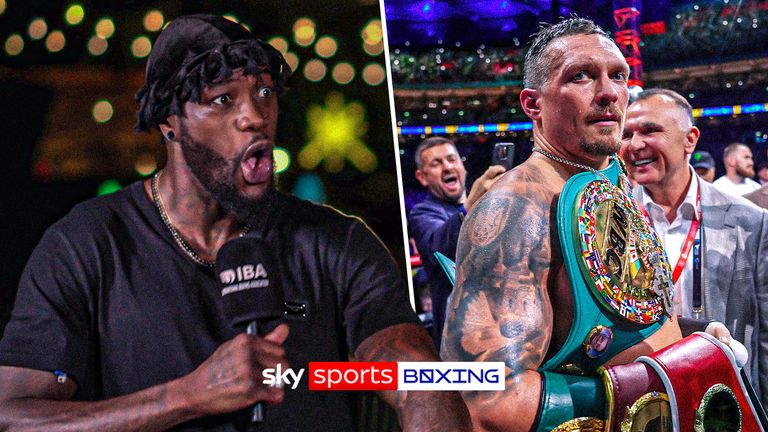
“I would think that would be the main recipe of it,” Wilder admitted in an exclusive chat with Bloody Elbow earlier this month at the IBA World Championships in Dubai. “I’m not going to give away too much on this interview because people are looking and I don’t want nothing to be heard.

“They might send something back and try to correct certain things, but I will keep it basic. I do have the speed and the height and the athleticism which are three things that give me an advantage.”

Oleksandr Usyk’s team offer positive Deontay Wilder fight update

After years of fighting in Riyadh and the UK as part of Riyadh Season under Turki Alalshikh, it seems that Oleksandr Usyk is finally coming back to America. He is reportedly in talks with a US-based outfit to stage what would be his first non-Saudi backed show since 2023.

Providing an update on the potential clash, Usyk’s manager Egis Kimas told The National: “It’s very likely (we will see Usyk vs Wilder). Because right now we’re working on it, and we’re working on some multi-fight agreement for Oleksandr.

“As soon as we’re going to confirm that, we’re going to jump in. And some talks are already going on with the team of Wilder. We’re looking at Las Vegas or Los Angeles, and the dates are the end of April, beginning of May.”

For his part when we spoke to Wilder three weeks ago, he said: “You’re dealing with my team in America and his team wherever they’re based at. Sometimes if they’re doing email and stuff like that it takes a little while.

“Negotiations take time because he wants something and I want something so we’ve got to meet in the middle and see what’s going on. He is the champion and I have to be a bit more lenient on certain things because of the opportunity.

“I’m very grateful for that and I have no problem with it, so negotiations are going very well and in the end we will see what happens.”